搜索
As an iconic Chinese symbol, an exhibition highlights the evolution of patterns that opened international dialogues throughout dynasties, Wang Xin reports.
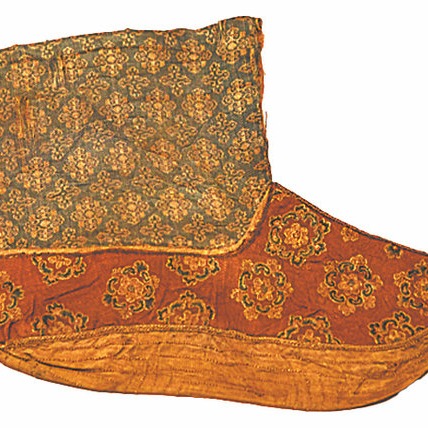
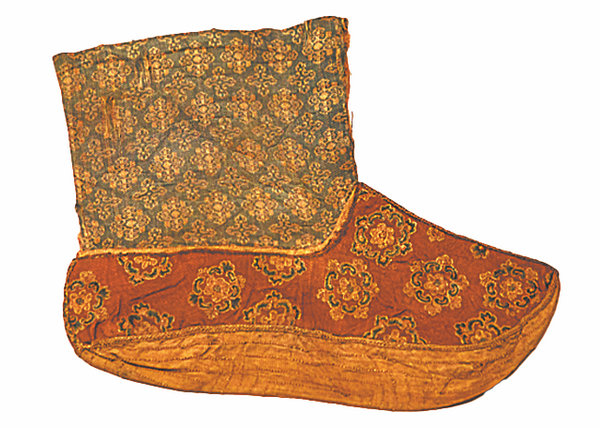
A Tang Dynasty (618-907) treasure flower motif inspired by Buddhist art. CHINA DAILY
Silk has been one of Chinese civilization's iconic cultural symbols over thousands of years. The unfading patterns are often seen as its soul, mirroring the culture and social conditions of that time as well as embodying ancestors' observations of nature and daily life.
An exhibition hosted by the Shanghai Social Sciences Development and Research Center and Donghua University Press opened on July 27 in Shanghai, bringing together over 100 representative silk patterns spanning five millennia.
Xie Fanhui of the Shanghai Social Science Museum, the exhibition's venue, shares with China Daily that outstanding traditional Chinese culture is one of the museum's main themes in its exhibition.
With this exhibition, we aim not only to trace the millennia-long evolution of silk patterns, but also to explore the Chinese cultural roots embedded within these silk patterns through visual, tactile and interactive displays, bringing them from the depths of history into the daily lives of the public, says Xie.
The grand silk scroll etched with splendid ancient civilization patterns begins in the Xia (c. 21st century-16th century BC) and Shang (c. 16th century BC-11th century BC) dynasties. Silk was often used to wrap ritual items during the period, and the patterns, mostly geometric shapes representing clouds and thunder, are deeply connected with the bronze culture, symbolizing the natural rhythms of the universe.
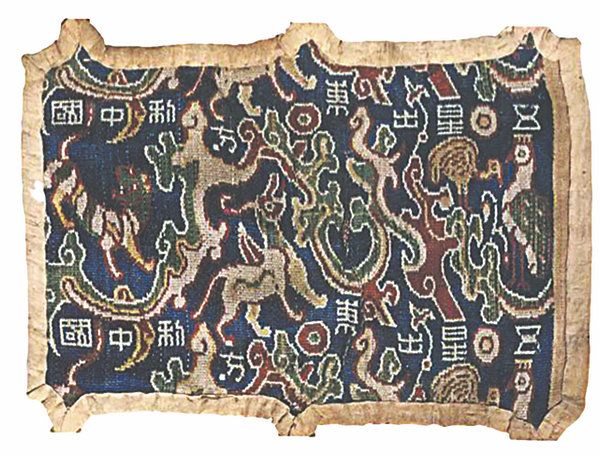
The national treasure-level Five Stars Rise in the East brocade arm guard, unearthed in 1995 at the Niya site in the Xinjiang Uygur autonomous region and now housed at the Xinjiang Museum, is regarded as one of China's earliest surviving calligraphic brocades. CHINA DAILY
Over the Spring and Autumn and Warring States periods (770-221 BC), silk weaving techniques saw significant progress, and the treadle loom emerged. Carrying on the traditions of the previous dynasties, the patterns became more complex during this time. They incorporated the Chu culture's unique charm, laying the foundation for the flourishing of silk art in later dynasties. Chu was a vassal state to the Western Zhou Dynasty (c. 11th century-771 BC) from about 2,000 years ago.
Representative patterns of the era include diamond patterns resembling ancient ear-shaped cups and dragon-phoenix-tiger motifs embodying the Chu people's worship of totems and their ideas of the supernatural world.
With the formation of a unified regime in the Qin (221-206 BC) and Han (206 BC-AD 220) dynasties, comprehensive ritual norms were established, and the Silk Road began to take shape. Confucian thought gradually integrated into folk aesthetics, and the silk patterns also reflect the bold, expansive characteristics of the era.
The representative cloud motif is regarded as the soul of Han Dynasty patterns. The pattern used fluid arcs to simulate clouds and was decorated with auspicious creatures to embody the Han people's pursuit of eternal life and immortality.
Calligraphic brocade with auspicious words and dogwood patterns was also popular at the time, including the national treasure-level artifact Five Stars Rise in the East brocade arm protector from the Xinjiang Museum, unearthed in 1995 at the Niya site in the Xinjiang Uygur autonomous region.
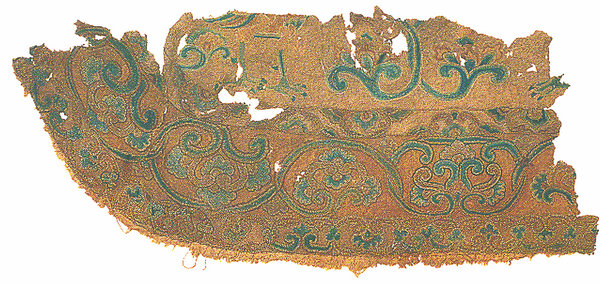
The Tangcao, or scrolling floral, motif, a hallmark of Tang Dynasty decorative art. CHINA DAILY
With the deepening of ethnic integration, the eastward expansion of Buddhism, and the prosperity of the Silk Road, more foreign elements began converging with Chinese cultures in the Wei, Jin, and Southern and Northern Dynasties (220-581), giving rise to several new motifs, including lions, elephants and peacocks, as well as beaded motifs and continuous, swirling honeysuckle patterns.
The Sui (581-618) and Tang (618-907) dynasties marked the golden age of ancient Chinese silk art. The nation's prosperity, cultural openness and craft innovations gave rise to elegant and grand silk patterns, including the harmonious Lingyang Gong pattern, the vibrant scrollwork or Tangcao pattern, and the treasured flower pattern featuring Buddhist culture.
Wen Run, curator of the exhibition and professor at the College of Textiles, Donghua University, summarizes the silk patterns of the Tang Dynasty at their peak prosperity as rich, lush, exotic, and vibrant.
The patterns were rich, diverse, full, and grand, combining a strong exotic flair with vivid colors. They showcased the dynasty's inclusiveness and openness as a major power, and even exerted a far-reaching influence on Japan and many parts of Southeast Asia, becoming a world-renowned symbol of Eastern aesthetics, Wen says.
As the agricultural civilization of the Central Plains underwent more profound interactions with nomadic civilization in northern China and the Islamic traditions from the Western regions, silk patterns of the Song (960-1279) and Yuan (1271-1368) dynasties further transcended ethnic boundaries and became more diversified in their themes and styles.
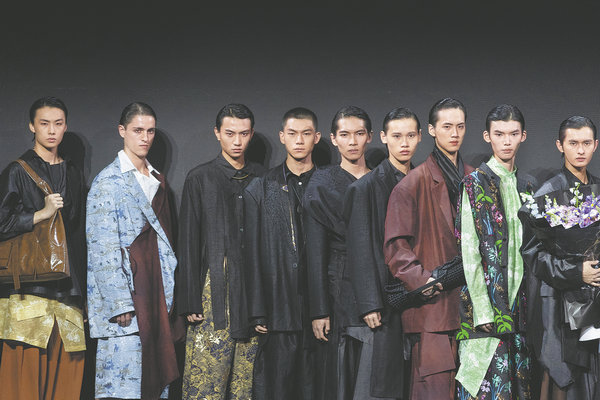
Models present creations during the JEANSWEST by Huang Gang runway show at China Fashion Week 2025 in Beijing on Sept 13, 2025. The collection reimagines traditional silk patterns with a fresh, contemporary edge. JESSICA LEE/FOR CHINA DAILY
Drawing inspiration from the natural world and everyday life, they not only showcase the refined and understated literary sensibilities of the Song Dynasty, but also incorporate the majestic and unadorned nomadic spirit of the Liao Dynasty (916-1125) and the diverse court styles of the Yuan Dynasty.
Traditional Chinese silk patterns and textile techniques reached a new peak in the Ming (1368-1644) and Qing (1644-1911) dynasties, during which the locally accumulated artistic essence of traditional patterns was delicately blended with extensive cultural exchanges with the outside world. Focusing on auspicious themes, the silk patterns also saw a deeper fusion of courtly aesthetics and folk tastes.
Since the late Qing Dynasty, traditional Chinese silk patterns became more simplified. Meanwhile, Western silk products began flooding the nation with refreshing designs, inspiring local innovation with more personalized modern aesthetics.
In the early 20th century, several unconventional motifs and design styles gained wide popularity in silk patterns, such as roses, tulips, creeping weeds, trumpets, pine cones, and plaid.
Wen explains that as traditional handweaving, plant-based dyes and the master-apprentice tradition gradually gave way to machine weaving, chemical dyes and modern educational methods, exotic motifs, including Western Art Nouveau and Art Deco styles, were integrated into local patterns.
After the founding of the New China, the silk industry played a critical role in contributing to the nation's economic development and diplomatic needs. In the 1950s, the Soviet Union and Eastern Europe were the main export destinations for silk products adhering to traditional styles. After the 1960s, the market shifted toward Western nations, and printed silk patterns grew rapidly.
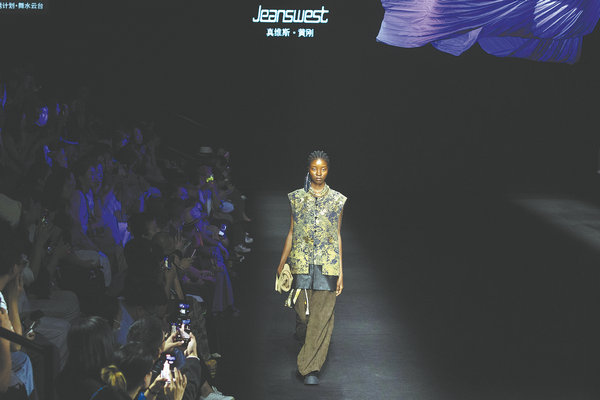
Models present creations during the JEANSWEST by Huang Gang runway show at China Fashion Week 2025 in Beijing on Sept 13, 2025. The collection reimagines traditional silk patterns with a fresh, contemporary edge. JESSICA LEE/FOR CHINA DAILY
As the nation launched reform and opening-up in 1978, the silk industry became more connected with the international art and design community. Silk patterns evolved from realism to abstract styles, and traditional Chinese techniques were cleverly refined to align with global fashion trends.
Wen notes that traditional silk patterns have drawn a fresh wave of public attention since 2001, when leaders of the APEC economies gathered in Chinese silk attire at the 2001 APEC meeting in Shanghai.
Entering the 21st century, traditional silk patterns, as a cultural heritage, are continuously evolving and increasingly integrated with modern digital technologies and design creativity, shining brightly again on the global stage.
Silk is a gift from China to the world. It is biodegradable, renewable, and sustainable. Silk patterns are symbolic carriers of our history, culture and the whole profound Chinese civilization. They are inclusive, continuously evolving with great vitality.
We hope more people will learn more about them, and discover the timeless beauty and charm of our traditional culture, says Wen.(By Wang Xin | China Daily Updated:Aug 7, 2026)
视频: 摄影: 撰写: 信息员:王宇 编辑:王宇